
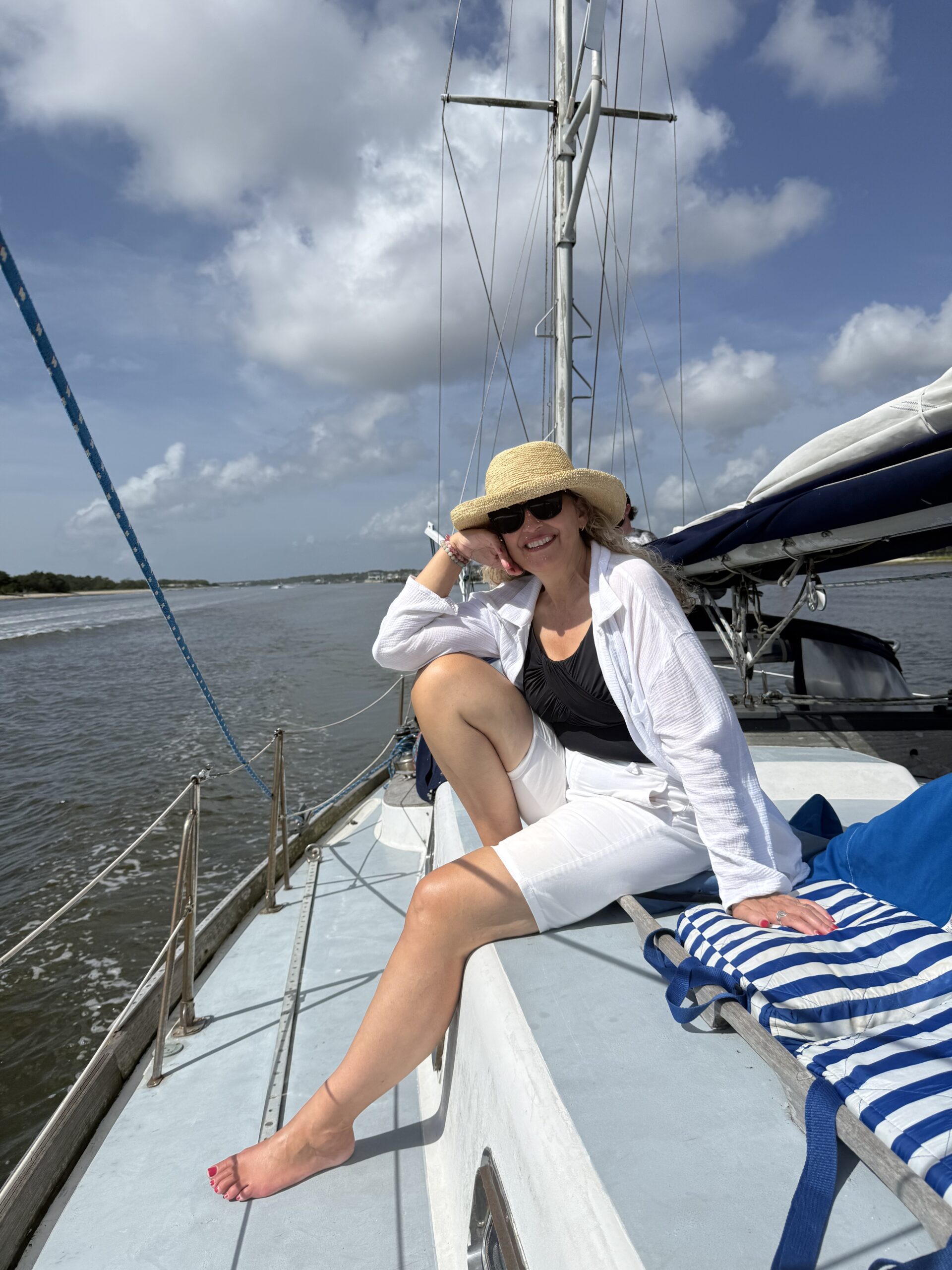
My name is Erika. Before I tell you my story, I want to tell you how it ends: I love hope.
If you had told me three years ago that those would become three of my favorite words, I would have wondered why. Three years ago, I never imagined I would be telling a lung cancer story of my own.
I am a wife, mother, grandmother, and someone living with stage 4 lung cancer. I’m blessed to share my life with my husband, Tom — my best friend and greatest supporter — and together we have two wonderful daughters and three precious grandchildren.
If you had asked me back then whether I thought I could ever get lung cancer, I would have said, “Absolutely not.” I was a teenager in the 1980s who completely bought into the “Just Say No” campaign. I never smoked. I always tried to take good care of myself — I ate healthy foods, drank water and coffee, exercised, and worked in health care. I knew, intellectually, that people who never smoked could get lung cancer. I just never imagined it would happen to me.
In early March of 2023, I had COVID for the first time. After I recovered, I was left with a lingering cough that just wouldn’t go away. In fact, it kept getting worse.
On May 23, I went to see my primary care physician. We both thought it was probably long COVID. And then, reluctantly, I showed him a swollen lymph node near my collarbone.
Everything changed in that moment. He immediately ordered an emergency CT scan. The very next day, he called and asked, “Are you sitting down?”
No one wants to hear those words from their doctor.
He told me the scan showed what appeared to be extensive cancer, including a tumor in the lower lobe of my left lung and cancer in lymph nodes throughout my chest. I was shocked. The only person more shocked than I was my husband. His beloved father had died of lung cancer after being a lifelong smoker, and like many people, he assumed lung cancer was a smoker’s disease. Neither of us imagined this could happen to someone like me.
I remember feeling physically sick. My mind immediately went to my daughters, my grandchildren, and all the moments I thought I might lose.
In the days that followed, I learned even more devastating news: the cancer had spread to my brain, and to many lymph nodes in my chest and stomach. Stage 4 lung cancer. Those words felt like the end of my future.
But those words were not the end of my story.
Then I met Dr. Namireddy. During our first visit, he said something that changed everything: there was a very good possibility I had a type of lung cancer driven by a genetic mutation that could be treated with a targeted therapy.
For the first time since my diagnosis, I felt something I hadn’t felt in many days. Hope.
He was so confident that biomarker testing would guide my treatment that he insisted we wait for the results before starting treatment. A bronchoscopy was scheduled, and tissue was collected for testing. Those two weeks waiting for results felt incredibly long. I knew the cancer was growing. I knew it was already in my brain. I felt like I was living on borrowed time.
Then came the evening of June 19, 2023. It was around 9 o’clock at night, and my husband and I were getting ready for bed when we both received a text message from Dr. Namireddy. The text said only three words:
“ALK mutation positive.”
A few moments later, he called, because he knew I wouldn’t know what those words meant. He was excited. Think about that for a moment — my oncologist was at home with his family, and yet he took the time to text and then call one of his patients because he knew those results couldn’t wait until morning. That simple act of kindness is something I’ll never forget.
In fact, he congratulated me. Imagine that — only an oncologist would congratulate you for the kind of cancer you have. He told me, “We can treat this. It’s not going to be too hard on you, and I believe it’s going to work.”
And just like that, hope came rushing back into my life.
I learned that not all lung cancers are the same. I learned the importance of biomarker testing. I learned that research matters. I learned that scientific discoveries made by people I will never meet could give me more time with the people I love most.
One thing this journey has also taught me is that lung cancer doesn’t discriminate, and neither should our compassion. Whether someone smoked, quit years ago, or never smoked at all, every person facing this disease deserves hope.
Today, more than three years later, Dr. Namireddy tells me he sees no evidence of disease. What wonderful words those are. We know the cancer is still there, unseen. We know my medication is keeping it under control. We pray that it will continue to do so for a very long time, and that the cancer never outsmarts it.
But today, I am doing something I once feared I might never be able to do again. I am living. Not just surviving. Living.
I am making memories with my husband of 38 years. I am watching my daughters continue to build their beautiful lives. I am enjoying every opportunity to love and spoil my three grandchildren.
And somewhere along this journey, I discovered something else I never expected: an incredible community.
The Lung Cancer Initiative didn’t just support me. It changed my life.
In September of 2024, I attended the Survivor Wellness Retreat. I arrived expecting to learn more about living with lung cancer. What I found was so much more. I found love. I found encouragement. I found joy. I found hope. I found friendships I will treasure for the rest of my life.
The people I met there are brilliant, courageous, deeply compassionate, and inspiring. They understand this journey in a way that few others can. They have expanded my world and enriched my life in ways I never could have imagined.
My gratitude to the Lung Cancer Initiative is immense. Their work goes far beyond research and advocacy — they create connections, they create community, and they help people find hope when they need it most.
When I was first diagnosed with stage 4 lung cancer, I thought my future had been taken from me. Today, I see things very differently. I believe research is advancing faster than ever before. Every discovery, every clinical trial, every breakthrough gives patients like me more reason to hope.
My hope is that because of continued research, one day everyone diagnosed with lung cancer will have more reasons to hope.
I’ve learned that hope isn’t wishful thinking. Hope is what gives us the courage to keep living while science keeps working.
Because of research. Because of physicians like Dr. Namireddy. Because of organizations like the Lung Cancer Initiative — I get to keep making joyful memories with the people I love.
So if there is one thing I hope you remember, it’s this:
Hope is powerful. Hope is worth investing in. Hope changes lives.
And after everything this journey has taught me, I love hope.