At 49 years old, I was diagnosed with Stage 1A lung adenocarcinoma in July 2025.
I was healthy, active, and had never smoked a day in my life—so the diagnosis came completely out of the blue. It was found incidentally during a CT calcium scan, which revealed an irregular mass in my lower left lung.
That scan changed everything. If the mass had been in my right lung, it likely would have gone undetected much longer and progressed to a much more advanced stage.
On August 25, 2025, I underwent a lower left lobectomy.
Even in the hospital, I knew how I wanted to approach recovery. I was not planning to stay cooped up inside without sunlight. I asked my surgeon for a note so I could go outside, and each day, with a nurse, I walked down holding my chest tube just to stand in the sunlight for 15 minutes in my hospital gown.
I’m also a big foodie, and even in the hospital, I found ways to lift my mindset—I would order from the full menu, including my decaf coffee, just to create small moments of normalcy and comfort.
That was my starting point.
At the same time, I was raising two young children and managing the full demands of daily life. Recovery didn’t happen in a quiet or controlled environment—it happened in the middle of everything.
There wasn’t space to step away from responsibility. So I learned how to heal within it.
My children were terrified when I was diagnosed. My daughter was just three, and my son was seven. They thought I might die.
But I told my son clearly: I am not planning to die—I am planning to live a very long life. That is my goal.
And then I showed them.
I began intensive pulmonary rehabilitation through WakeMed Pulmonary Rehab, working with a therapist twice a week for three months. During that time, I encountered some of the most knowledgeable and supportive therapists—people who truly believed in me. That support mattered, and it helped me begin rebuilding my lung capacity safely and intentionally.
From there, I transitioned into running.
I was never a runner before—but I am now. I am a runner. I am an athlete. That is my mindset.
Running became more than exercise—it became a critical part of my recovery. It helps regulate me mentally, and it has been one of the most effective ways for me to rebuild my lung capacity and endurance.
Three days a week, I trained—gradually and intentionally—pushing through the discomfort that comes with healing and rebuilding. I still experience daily stabbing pain in my left ribs, likely from nerve damage, and I do my best to keep my mind from focusing on it.
I continue to do breathing exercises three times a day to expand my lung capacity, and my children now ask to do them with me. They are watching all of this up close.
Progress wasn’t linear, and there were many days I felt exhausted before I even started. But I kept going.
I am actually more active now with one and a half lungs than I was before my diagnosis.
I track my progress closely—monitoring my heart rate on my Garmin watch, and using my ring—Conn ring—to measure my HRV and recovery, approaching my healing with both discipline and intention.
On pulmonary function testing with my pulmonologist, my lung capacity was initially measured at 126%. After my lobectomy—and through consistent, hard work—it is now at 108%.
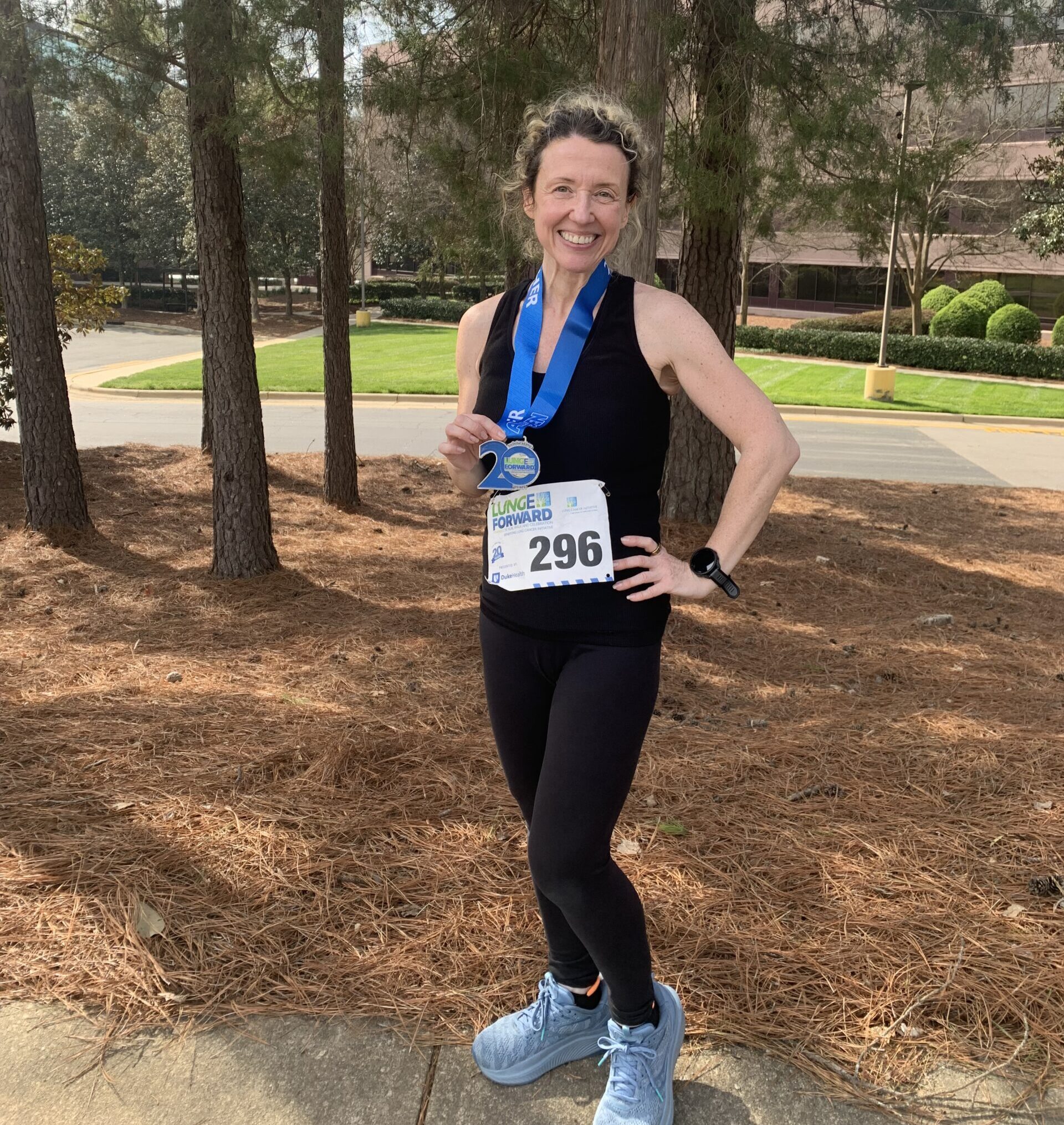
When I showed up for my 5K, I wore the clothes I train in—the ones I feel strongest and most comfortable in. I didn’t come just to finish.
I came to compete.
I came to thrive.
Less than seven months after my surgery, I ran my first 5K.
It was also my first timed race.
And I finished second in my age group.
That moment represented more than the race itself. It reflected months of persistence, discipline, and choosing to continue showing up for myself—even when it was difficult and even while carrying a lot on my own.
My children have watched that resilience up close. Recently, my son told me he wants to run a 5K just like me. My children are my greatest supporters from Day 1.
That is the greatest life lesson I could ever give them.
I will continue to have scans for the rest of my life. This is now part of who I am.
I am still in recovery. My lung capacity is still improving. This is ongoing work.
I’ve never been average—and this is just another form of that. Not because it was easy, but because I chose to keep going anyway.